
A “good” car seat is defined by robust mechanical fundamentals—safety, ergonomics, durability, and NVH (noise control)—rather than superficial features like massage or heating. True comfort stems from precise pressure distribution and rigorous engineering validation (like 65,000-cycle durability tests), ensuring the seat remains silent and supportive for a decade. Features are bonuses; rock-solid engineering is the prerequisite.
Table of Contents
People often ask me: Does simply cramming a seat full of heating, ventilation, and massage features automatically make it a good auto seat?
Here, I can give you a definitive answer: Absolutely not!
To use an imperfect analogy: if throwing heating, ventilation, and massage into a seat automatically made it great, wouldn’t that mean anyone handed the right ingredients could instantly become a Michelin-star chef?
Obviously, the world isn’t full of master chefs, and not every feature-packed car seat is actually going to feel comfortable when you sit in it.
Back when I worked for an automaker, I was dispatched overseas for a facelift project where the seats were one of the primary redesign targets. Recently, I was also invited to tour Buick’s dedicated seat R&D center. Below, drawing on my own insights and past experience in car seat design and development, I will break this down through a 3-part Q&A. What exactly needs to be considered to create a truly “good” seat?
What conflicting factors must engineers balance during seat design?
Before diving into specific design factors, let me share a universal truth in the automotive design world: Every single component involving exterior or interior contoured surfaces is the result of a brutal tug-of-war and ultimate compromise between visual styling and engineering feasibility. Today’s focus isn’t on the aesthetics of surface styling, but rather on what must be considered from an engineering execution standpoint when designing a car seat.
(1) Structural Feasibility
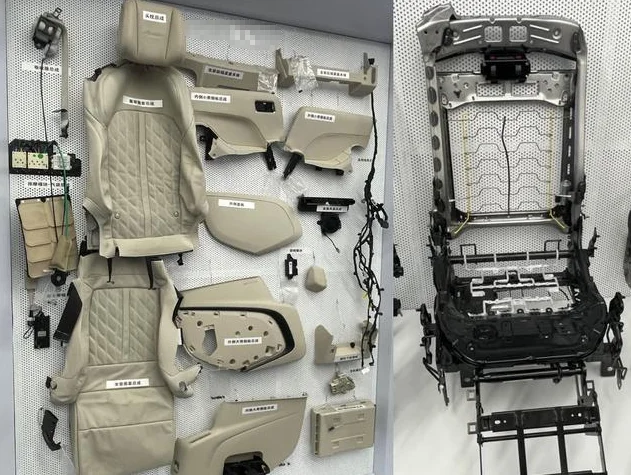
Looking at the components of a seat, it consists of stamped sheet metal frames, leather upholstery covers, supportive foam pads, plastic control buttons, and more. For all of these, engineers must consider mold draft angles and whether the parts might be scratched during ejection. Are the radii on the cover base too sharp? Will they pierce through the leather upholstery? The parting lines and flash on the plastic buttons must also be examined—will they cause any discomfort or scraping against the user’s fingers during operation? Once individual parts are manufactured, can they actually be assembled together without issues? All of this falls under the umbrella of structural feasibility.
As you can see, the starting point of seat development is absolutely not, “Should we add massage or heating?” First and foremost, the seat is a critical structural component of the vehicle.
(2) Ergonomics
A car seat isn’t a living room sofa; it’s an integrated component within a vehicle cabin, meaning its relationship with surrounding parts must be carefully considered.
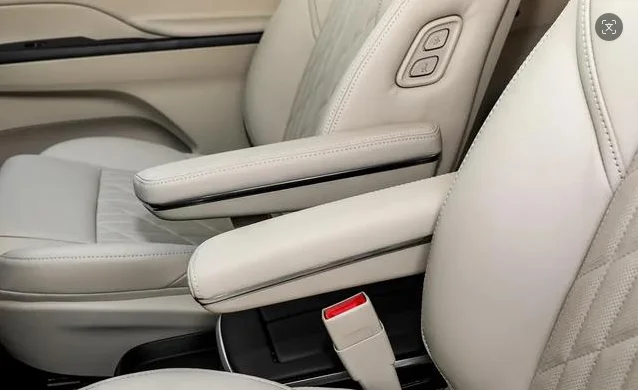
For example, the most intuitive example: if the front seat is pushed all the way back and the backrest reclined, it might seriously encroach upon the rear legroom, leaving second-row passengers extremely cramped. That is a clear ergonomic issue.
Another example: within the seat’s adjustable range, if you find yourself straining to reach the seatbelt—that’s another ergonomic issue.
Similarly, if the design of the second-row seats makes accessing the third row extremely difficult, that’s yet another ergonomic issue.
Therefore, during the design phase, the seat is treated as a dynamic object, and its entire range of motion must be engineered to avoid interfering with the operation of any other functions or buttons in the cabin.
(3) Crash Safety
This is easy to grasp: the moment a collision occurs, the seat, being the component in closest contact with the passenger, must act as the first line of defense. You should now realize that the anchoring between the seat tracks and the chassis is of paramount importance.
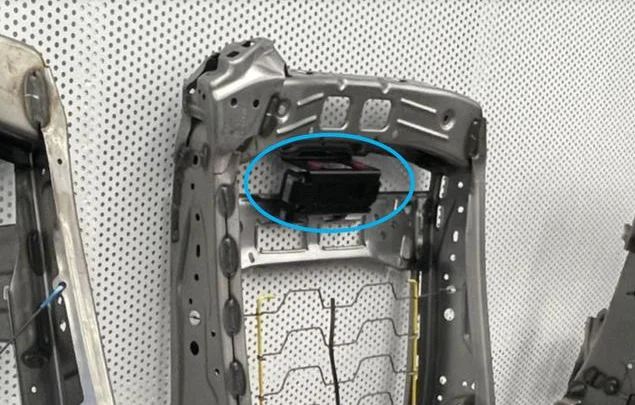
If the seat backrest bends or buckles under impact, the damage to the passenger’s lower back can be severe; similarly, if the headrest lacks sufficient support, the impact on the neck can be easily imagined. Therefore, the seat must offer formidable structural integrity to provide robust, unyielding support the millisecond an impact occurs.
(4) Durability
This relates directly to the individual components themselves. This encompasses frame durability, foam durability, upholstery durability, and so on.
Put simply, durability means answering the question: after years of relentless use, will the seat’s functionality and comfort remain exactly as they were on day one?
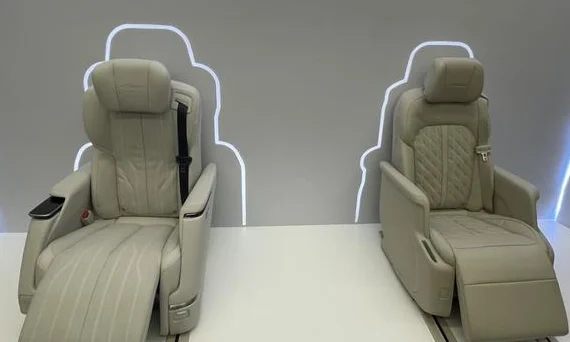
Take foam durability, for instance. The firmness of the foam dictates the delicate balance between comfort and support. It is undeniably at its peak fresh out of the factory. However, if after a year or so of use the foam undergoes permanent compression set (meaning it stays permanently deformed and fails to rebound), its comfort and support are entirely compromised.
Durability is even more critical for rigid components like the metal frame. If the frame’s durability is compromised, it directly jeopardizes the passenger’s life.
(5) Comfort
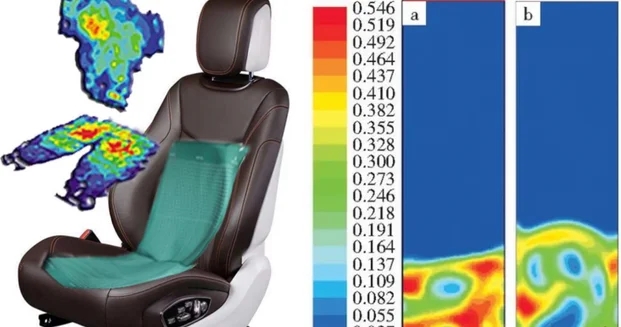
You’ve likely noticed this while riding in cars: in some cars, you’re left with a sore back and aching muscles after just two hours, while in others, your body remains relatively relaxed no matter how long the drive. Beyond the surface material, what matters most is whether the contour of the foam fits the human body well. For instance, if the lumbar region is left unsupported and hovering, those muscles must remain continuously tensed. After a while, lactic acid builds up, leading to soreness.
During design, the most objective approach is to map the seat’s pressure distribution. Areas with high pressure indicate where muscles are forced to exert effort, while areas with low pressure indicate light contact or hovering. The engineer’s goal is to equalize the pressure across the body—reducing spikes in high-pressure zones and filling in low-pressure gaps—so the entire body is supported by a moderate, evenly distributed pressure. This is the absolute key to achieving physical relaxation.
Behind the scenes, the shape of the foam, the density of the materials, and the resulting bodily posture all play a role. Automakers with deep engineering heritage purposefully engineer specific “seat DNA” to control the shape and positioning of the seat surfaces. This indirectly guides the passenger’s posture, keeping them positioned within the optimal pressure-distribution zone to ensure a sense of physical relaxation.
(6) Noise, Vibration, and Harshness (NVH)
In other words, noise control. Some people might wonder: do seats really have acoustic requirements?
Absolutely, and it’s incredibly important!
You have to remember that a seat assembly is made up of numerous parts—headrests, backrests, armrests, leg extensions, etc. Many of these parts are dynamic and movable, meaning there are necessary gaps. If the manufacturing tolerances between these parts aren’t strictly controlled, they will rub against each other while driving, resulting in the dreaded “squeaks and rattles”.
Furthermore, every component has its own natural frequency. If that frequency aligns with the vehicle’s driving vibrations, the seat will experience resonance-induced vibration, which undoubtedly compromises the ride experience. Therefore, during design, engineers meticulously define tolerances and resonant frequencies, validating them through grueling testing regimens.
Comparatively speaking, consumers generally have a somewhat deeper understanding of structural feasibility, crash safety, and durability, and I’ve seen quite detailed answers about these on Zhihu. But seat NVH and acoustics? This might be the first time many of you are hearing about it, so I’ll gladly expand on it:
When we talk about seat NVH, what exactly are we focusing on?
As just mentioned, seat NVH refers to the aggregate noise and vibration emanating from the seat that is perceived by passengers while the vehicle is in motion. Generally speaking, a car seat‘s NVH performance is influenced by several core factors:
(1) Kinematic Clearance Checks
This is the absolute baseline.
Take the relationship between the front seat and the center console as an example. You must ensure that when the seat slides forward or backward, it completely clears the center tunnel. This also means ensuring that as the backrest is reclined, it doesn’t interfere with surrounding parts such as the door panels or the B-pillar.
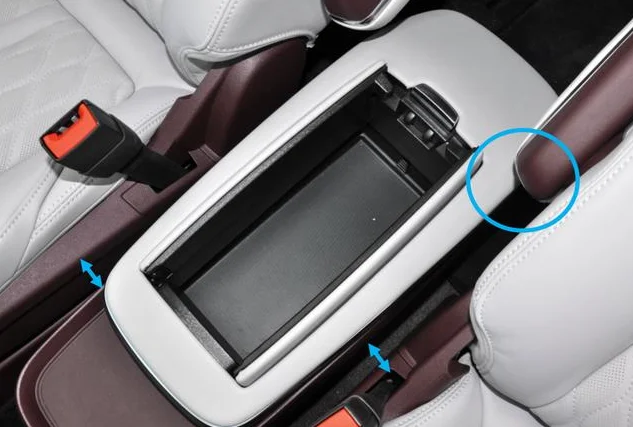
If it rubs, you instantly get harsh rubbing noises. Furthermore, engineers must consider whether the side-mounted seatbelt buckle will strike or scratch the center console as the seat moves.
Someone might ask, “Isn’t that easy? Just make the seat narrower!”
If you actually did that, you’d be hit with an avalanche of customer complaints. Reducing the width of the cushion or backrest inherently reduces the seat’s bodily support, compromising comfort, while simultaneously shrinking the passive safety buffer provided by the seat frame.
(2) Upholstery Materials
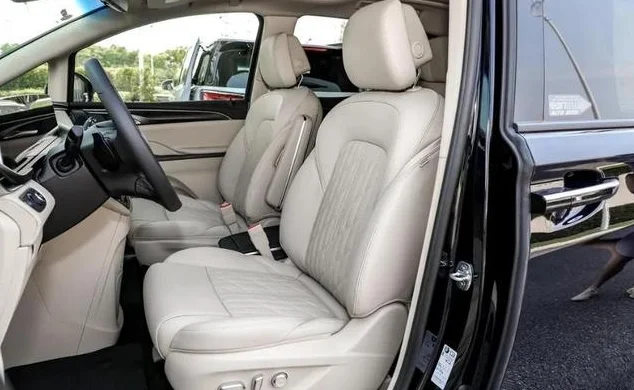
If you’ve ever compared standard PVC synthetic leather to premium Nappa leather, you’d notice a distinct difference in their acoustic signatures.
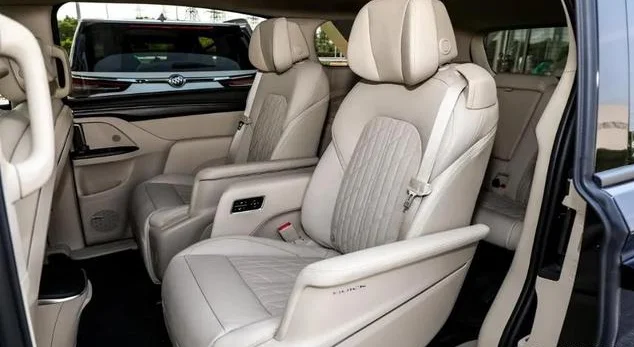
Designing premium leather seats is truly expensive. For example, the single curved stitch line on the backrest shown in the diagram requires manual sewing. And not just by anyone—it requires a master seamstress with over 5 years of experience, as only that level of skill can guarantee the fluidity of the curve. Look at the quasi-diamond quilting with its highly intricate perforations; the specialized tooling for that single piece of leather costs in the tens of millions. Before this, I only knew that more premium leather cost more; I had no idea how deep the rabbit hole went.
(3) Seat Assembly and Fitment
As a former surface styling designer, this point resonates deeply with me.
A problem we constantly faced was this: In the theoretical design phase, all seam gaps and surface alignments are perfectly uniform. However, in physical manufacturing, we are forced to account for tooling errors, assembly deviations, and more. Because a seat assembly contains so many parts, these tolerances stack up rapidly. The end result is parts interfering with each other, meaning friction and squeaks.
The hallmark of excellent engineering is not merely enforcing strict manufacturing tolerances on individual parts, but also striving for excellence in the final assembly process to keep cumulative tolerances strictly within the design spec—getting as close to the intended design state as possible.
Moreover, the welding process for the seat frame must bond the metal components as tightly as possible to reduce friction and vibration between them, while also enhancing the strength of the seat. The same applies to the frame itself. Look at this design detail on the seat frame: Notice how clean the stamped holes are, completely devoid of burrs, and how the sharp edges feature rolled-hem designs.
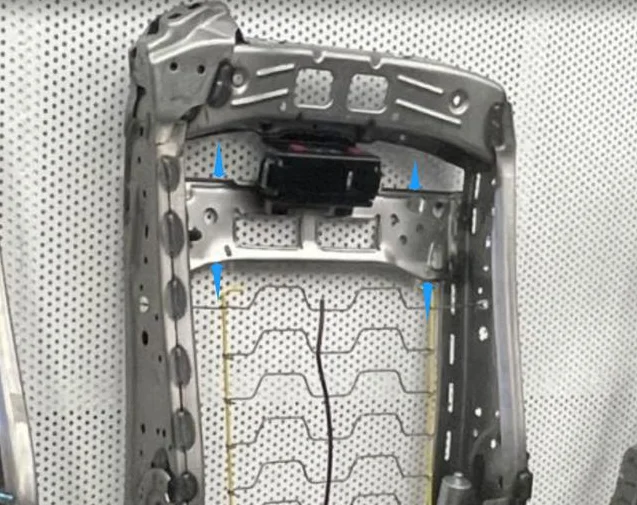
Achieving this isn’t necessarily difficult in terms of technology, but it inevitably adds significant costs, as it requires more complex manufacturing processes and demands that every single stamped hole is pristine and every sharp edge features a rounded-edge design.
How do you guarantee a seat remains dead silent over the entire lifespan of the vehicle?
Is it enough to ensure the seat is quiet on the day it’s delivered to the customer?
Obviously, that’s nowhere near enough!
Assuming a car sees 5 ingress/egress cycles a day over an 8-year lifespan, that seat will be used 14,600 times. The critical question is: How do you guarantee that after 14,600 uses, the internal components won’t loosen or rub?
At the auto seat manufacturing plant, they subject seats to a grueling gauntlet of 101 tests across seven major categories: static strength, dynamic safety, storage fatigue, misuse measurement, vibration fatigue, NVH comfort, and material science. I’ll highlight a few of these testing methodologies to give you an idea.
(1) Ingress/Egress Testing
Simply put, a robotic arm repeatedly simulates a human getting in and out of the car to validate the seat’s extreme wear resistance.
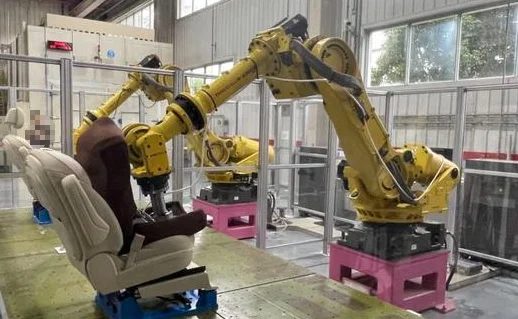
My hypothetical 15,000 cycles over 8 years is actually a highly conservative estimate. Top-tier seat development standards mandate up to 65,000 cycles to simulate the vehicle’s maximum lifespan—and they run this test with the seat heaters cranked on! The downward force applied per cycle (simulating the weight of a sitting passenger) hits 1,000 N, roughly equivalent to 100 kg. Surviving this unrelenting mechanical “abuse” essentially guarantees that over a decade of ownership, the seat will never collapse, deform, or develop rattling parts.
(2) Armrest Durability Testing
In tandem with the main seat testing, there are specific protocols for armrest durability.
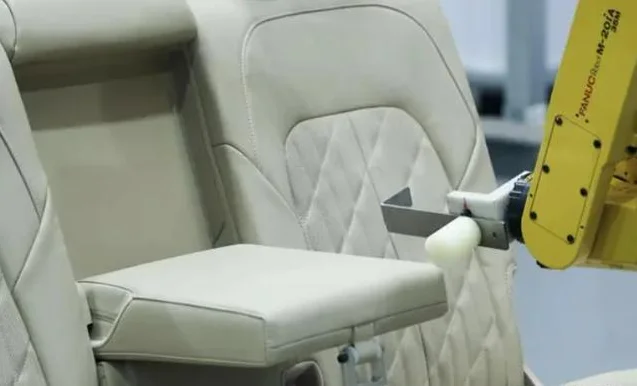
The armrest sees extremely high usage and is highly prone to wear. For this component, a premium standard demands flawless folding operation even after 5,000 cycles.
Crucially, engineers must verify that after 5,000 flips, the armrest returns to its exact factory position, and that the armrest leather hasn’t begun rubbing against the seat leather to produce squeaking noises.
(3) Squeak and Rattle Testing
This test takes place inside an NVH hemi-anechoic chamber. The metallic rods you see in the image below have microphones at their tips—nine of them in total.
Here, we need to introduce a new concept: The Sone value. Originally, the Sone was a direct measurement of perceived loudness, a subjective psychoacoustic scale where 1 Sone equals the loudness of a 1,000 Hz pure tone at 40 decibels. During Buick’s seat development, Sone values are utilized to measure human sensitivity to sound, enabling a better evaluation of cabin quietness.
So, how does it differ from decibels? Simply put, Sone values are more stringent and nuanced than decibels. Two sounds might register at identical decibel levels, but yield different Sone values. A higher Sone value means the sound is more jarring and unpleasant; a lower Sone value means the sound is more pleasant.
According to a demonstration by the lab engineers, if two sounds both register at 90dB, the gentle tapping of a cup might measure 25 Sones, while a harsher sound can reach 35 Sones.
The seat squeak and rattle test is designed to perform a series of tasks including testing and evaluating the noise conditions of the entire seat assembly, with one sole purpose: To ruthlessly drive down the Sone value, guaranteeing that any noise emitted by the seat under dynamic load stays strictly under 7 Sones. From my own firsthand experience inside the lab, unless you hold your breath and listen intently, it is extremely difficult to perceive any noise coming from the seat during vibration testing.
But this brings us back to the earlier question: we’ve made the brand-new seat silent, but will it stay that way after years of abuse?
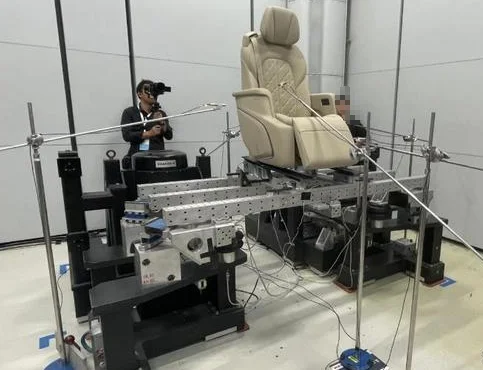
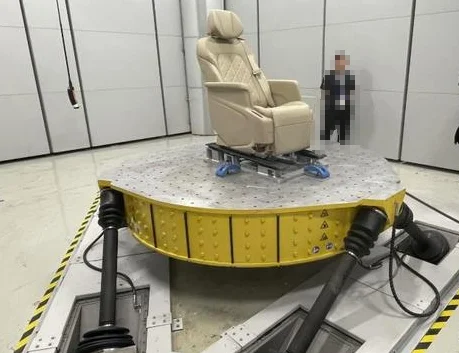
The ultimate validation tool for this is the six-axis vibration test rig. It is the rig shown in the image above.
Six-axis means it manipulates the seat across X, Y, and Z axes with six degrees of freedom, recreating multi-dimensional vibrations to simulate a wide variety of road conditions. R&D engineers use this rig to simulate the most brutal road surfaces found across the country, perfectly replicating the physical degradation of a seat after years of heavy use.
Combined with the visual simulation on the monitors, the rig’s fidelity is so high that sitting on it genuinely feels like driving down a battered road.
After the prolonged comprehensive vibration test, the seat is returned to the previous laboratory for noise testing. This ensures that after prolonged use, the 7-Sone noise standard can still be maintained. At this point, and only at this point, can a seat be considered fundamentally “qualified”.
What Should We Pay attention to?
Have you noticed?
Up to this point, we haven’t even mentioned features like heating, ventilation, or massage. We’ve remained entirely focused on the absolute fundamental aspect of “sitting”. Merely ensuring a seat is comfortable, silent, and stable demands an immense amount of behind-the-scenes engineering.
Regarding the feature-stuffed seats the original poster mentioned: if they have first undergone this level of rigorous engineering validation, and then added all those luxury features while guaranteeing long-term durability, then yes, they are undeniably excellent seats.
Conversely, if a manufacturer has not put in the hard work on basic comfort, and instead merely emphasizes a rich feature set, then my answer is a hard no.
While I was working on projects in Europe, my mentor constantly repeated one phrase: “Der liebe Gott steckt im detail” (God is in the details). Returning to the opening question: why am I so adamant that simply piling on heating, ventilation, and massage does not automatically equal a good seat? Because I don’t want buyers to fall into this common misconception when choosing a car. Especially in today’s era of rapid digitalization, I strongly urge everyone not to ignore the foundational mechanical integrity a vehicle must possess. Features like heating, ventilation, and massage are fantastic bonuses, but they are absolutely not the core prerequisites that make a seat physically comfortable and structurally safe. Established automakers like GM, with their time-tested, successful models, draw on decades of automotive engineering heritage. Yet, they rarely market these “features” as their main selling points. Instead, they take great pride in patiently and proudly showing us their deep considerations in durability, quietness, and craftsmanship.
Ultimately, it comes down to this: Whether you are buying a car or building one, you should never put the cart before the horse, sacrificing rock-solid engineering fundamentals just to chase flashy, superficial gimmicks.
Key Takeaways
- “God is in the Details”: From rolled-hem edges on metal frames to the specific acoustic signature of Nappa leather, superior quality is hidden in microscopic engineering choices.
- Fundamentals Over Features: Heating, ventilation, and massage are “luxury spices,” but the “main course” must be structural integrity and ergonomic support.
- Engineering Equilibrium: Designers must balance a “brutal tug-of-war” between visual styling, manufacturing feasibility, and crash safety.
- The Science of Comfort: True physical relaxation is achieved by mapping pressure distribution to eliminate high-pressure spikes and unsupported gaps.
- Acoustic Excellence (NVH): High-quality seats aim for a Sone value under 7 to ensure silence. This requires strict tolerance control and resonance testing.
- Lifespan Validation: Premium seats undergo extreme “abuse” tests, such as 65,000 ingress/egress cycles under 1,000 N of force, to guarantee they won’t deform or rattle over time.
- Toyota Sienna Luxury Modification with Aviation Seats: A Premium Business MPV Upgrade
- Buick GL8 Luxury Modification: Creating a Premium Business Class Interior with Aviation Seats
- Toyota Alphard Luxury Modification: From Fairytale Dream to Executive Business Lounge
- Toyota Coaster Luxury Bus Modification: VIP Aviation Seats and Premium Interior Upgrade
- Land Rover Modification: Comprehensive Upgrade of Red Seats and Interior